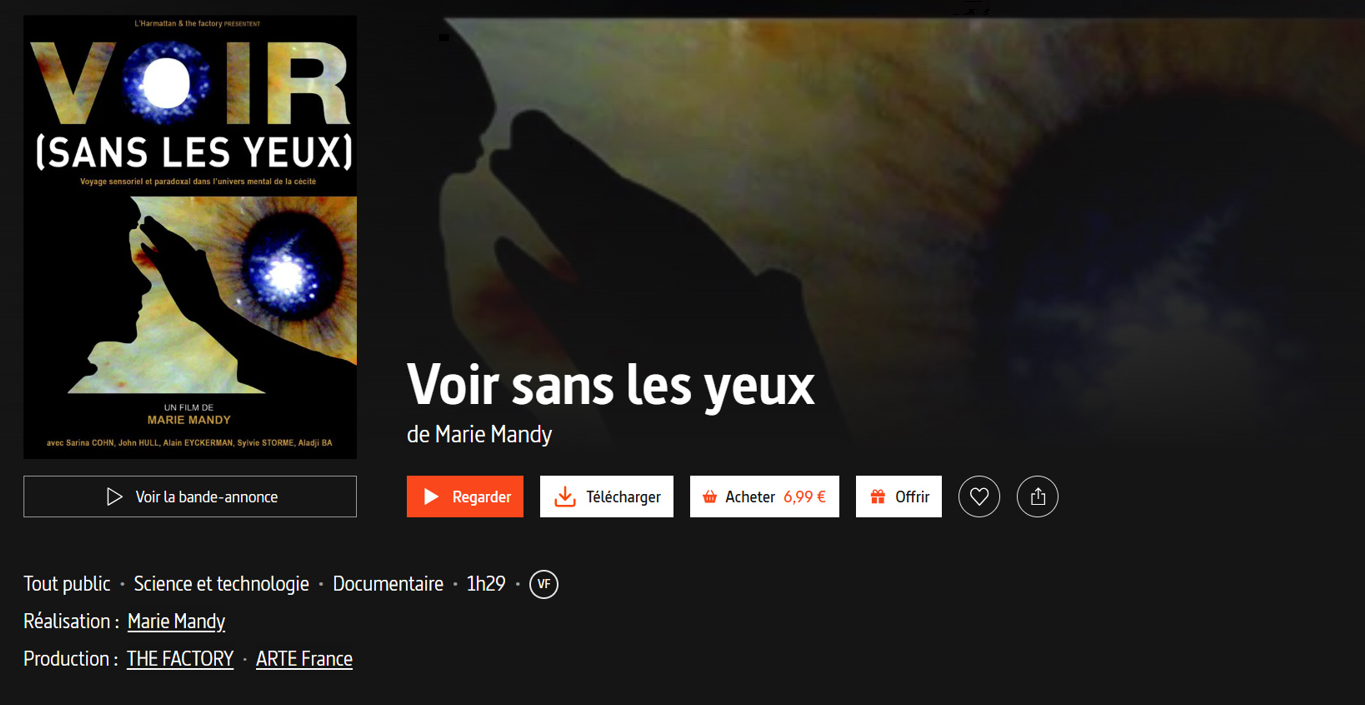


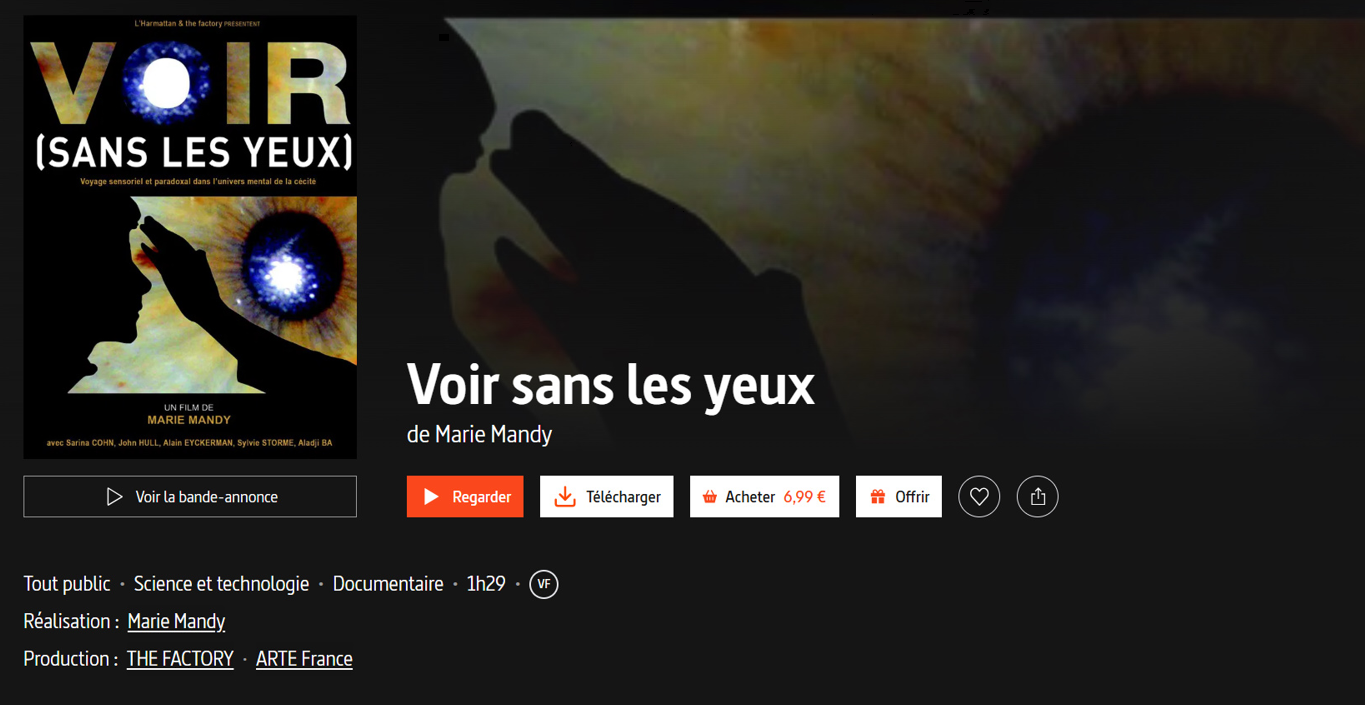
Voir sans les yeux - a movie by Marie Mandie
Voir (sans les yeux) (“Seeing Without Eyes”) is a 2004 French-language documentary directed by Belgian filmmaker Marie Mandy. The film is a contemplative exploration of blindness and perception, examining how individuals who are blind or visually impaired experience and interpret the world. Rather than focusing on spectacle or sensational claims, the documentary approaches its subject with philosophical depth and emotional sensitivity. It asks a deceptively simple yet profound question: what does it mean to see?
At the core of the film is an inquiry into the nature of mental imagery when visual input is absent. Marie Mandy follows several blind and partially sighted individuals, including those who lost their sight later in life and others who were blind from birth. Through intimate interviews and carefully observed daily scenes, the participants describe how they construct internal representations of their surroundings. For those who once had sight, visual memory plays an important role; images from the past continue to shape their imagination and spatial orientation. For those born blind, however, perception is structured differently. Their “images” are not visual in the conventional sense but are composed of sound, touch, movement, temperature, and emotional cues. The film demonstrates that perception is not extinguished in the absence of sight; rather, it reorganizes itself.
One of the documentary’s most compelling aspects is its attention to how the other senses expand and refine themselves. Participants explain how echoes reveal the dimensions of a room, how subtle shifts in air pressure signal proximity, and how footsteps define distance and direction. Sound becomes architectural, mapping space with remarkable precision. Texture and vibration convey information that sighted individuals often overlook. In presenting these testimonies, the film challenges the dominant assumption that vision is the primary gateway to reality. Instead, it suggests that perception is a multisensory construction, shaped by cognitive interpretation as much as by sensory input.
Beyond sensory adaptation, Voir (sans les yeux) explores the psychological and emotional consequences of blindness. The film addresses the grief associated with losing sight, the gradual fading of remembered images, and the existential adjustment required when one’s perceptual world changes fundamentally. Some participants speak about the unsettling experience of visual memories dissolving over time, while others describe a mental life that no longer depends on visual imagery at all. The documentary thus becomes a meditation on memory, identity, and the human capacity for adaptation. It presents blindness not merely as a medical condition but as a transformation of perceptual experience.
Marie Mandy’s cinematic approach reinforces the film’s thematic concerns. The pacing is deliberate and reflective, allowing silence and ambient sound to carry meaning. Close-up interviews create intimacy without intrusion. The camera often lingers on textures, surfaces, and soundscapes, subtly shifting emphasis away from visual dominance. Rather than explaining blindness from an external perspective, the film allows those who live with it to articulate their own realities.
Philosophically, the documentary invites viewers to reconsider the hierarchy of the senses in Western culture, where vision is typically privileged as the most reliable mode of knowing. It raises fundamental questions about whether seeing is purely optical or deeply cognitive. How much of what sighted individuals call “reality” is constructed by the brain? To what extent is perception always an interpretive act, even when the eyes function normally? In this way, the film does not merely describe blindness; it uses blindness as a lens through which to examine perception itself.
Ultimately, Voir (sans les yeux) is a quiet yet intellectually resonant documentary that reframes the concept of vision. It suggests that seeing is not limited to retinal activity but involves the mind’s capacity to organize, remember, and assign meaning. By listening to the lived experiences of blind and visually impaired individuals, the film encourages viewers to question their own assumptions about perception. It is less a film about the absence of sight than about the richness of alternative ways of knowing the world.
Voir (sans les yeux) from the Perspective of MatrixVision – Seeing Without Eyes
Marie Mandy’s documentary presents blindness primarily as an adaptation to the absence of retinal input. The individuals portrayed in the film reorganize their perceptual world through sound, touch, memory, and spatial awareness. The film is reflective and humane, but it remains within a conventional framework: perception is reconstructed from the remaining biological senses.
From a MatrixVision perspective, however, the conversation could have extended further. MatrixVision proposes that perception may not be strictly limited to the classical five senses, but that human cognition might access information through alternative, non-ocular channels. While Voir (sans les yeux) examines how the brain compensates for the loss of sight, MatrixVision explores the possibility that vision itself may not be exclusively dependent on the biological eyes.
In the documentary, the children and adults describe how they build mental representations from soundscapes, textures, and remembered images. Their perceptual field is adaptive, intelligent, and often surprisingly precise. Yet the framework presented assumes that sight, once lost, cannot be functionally replaced in a direct way. MatrixVision challenges precisely this assumption. It suggests that, under certain training conditions, individuals may be able to develop structured perceptual access that is not mediated by the optical system.
Had the children featured in the film been introduced to such a structured training methodology, their experiential trajectory might have unfolded differently. Instead of adapting solely by compensating with other senses, they might have explored the development of a parallel perceptual channel. This is not about imagination or metaphorical “inner vision,” but about training attention, signal discrimination, and cognitive filtering in a systematic way. MatrixVision posits that perception involves distinguishing signal from mental noise — including internal dialogue, expectation, and emotional interference — and that this skill can be cultivated deliberately.
The film portrays blindness primarily as loss followed by adaptation. MatrixVision reframes the situation as potential followed by activation. In this view, blindness would not only require compensatory strategies but could also become an entry point into exploring latent perceptual capacities that sighted individuals rarely investigate. The difference is philosophical as much as practical: one model assumes limitation and adjustment, the other assumes dormant capability and training.
Importantly, this does not diminish the value of Voir (sans les yeux). The documentary remains a powerful exploration of lived experience and sensory reorganization. However, it stops at the threshold of a larger question: is perception ultimately bound to sensory organs, or is it fundamentally a cognitive process that can operate through alternative pathways? MatrixVision situates itself precisely at that threshold.
If the children depicted in the film had been introduced to structured perceptual training aimed at developing non-ocular vision, their narrative might have shifted from adaptation to exploration. Instead of asking how to live without sight, the inquiry might have become how to expand perception beyond conventional sight. Whether one accepts this hypothesis or not, it undeniably reframes the discussion from coping with loss to investigating human potential.
In this sense, Voir (sans les yeux) and MatrixVision address the same domain — perception without reliance on the eyes — but from different conceptual starting points. The film documents adaptation within established sensory theory. MatrixVision proposes a systematic exploration beyond it.